
Public safety & law enforcement strategy.
Help special districts and local governments make better use of crime data, law enforcement resources, security technology, and contracted patrol.
How DDG helps.
DDG provides an independent layer of strategy and oversight between the Board, its public safety resources, and the agencies serving its community. We assess, prioritize, coordinate, and remain accountable through implementation and ongoing oversight.
- Understand the environment
- Establish priorities
- Develop the strategy
- Coordinate resources
- Measure results
- Report back to leadership
Crime & public safety intelligence
Turn crime reports, incident data, ALPR activity, and other available intelligence into a clear picture of what is happening across the district.
Public safety strategy & resource planning
Translate risk and activity into practical decisions around patrol, technology, law enforcement coordination, and other public safety resources.
Patrol program development
Design contracted and off-duty law enforcement programs around the district's needs, priorities, and budget.
Law enforcement coordination
Work with law enforcement partners to align priorities, improve communication, address emerging concerns, and connect district leadership with the agencies serving their communities.
Performance, oversight & Board reporting
Evaluate activity, response, and outcomes to determine whether resources are being used effectively, and give the Board clear, actionable reporting.
Clarity your board
can act on.
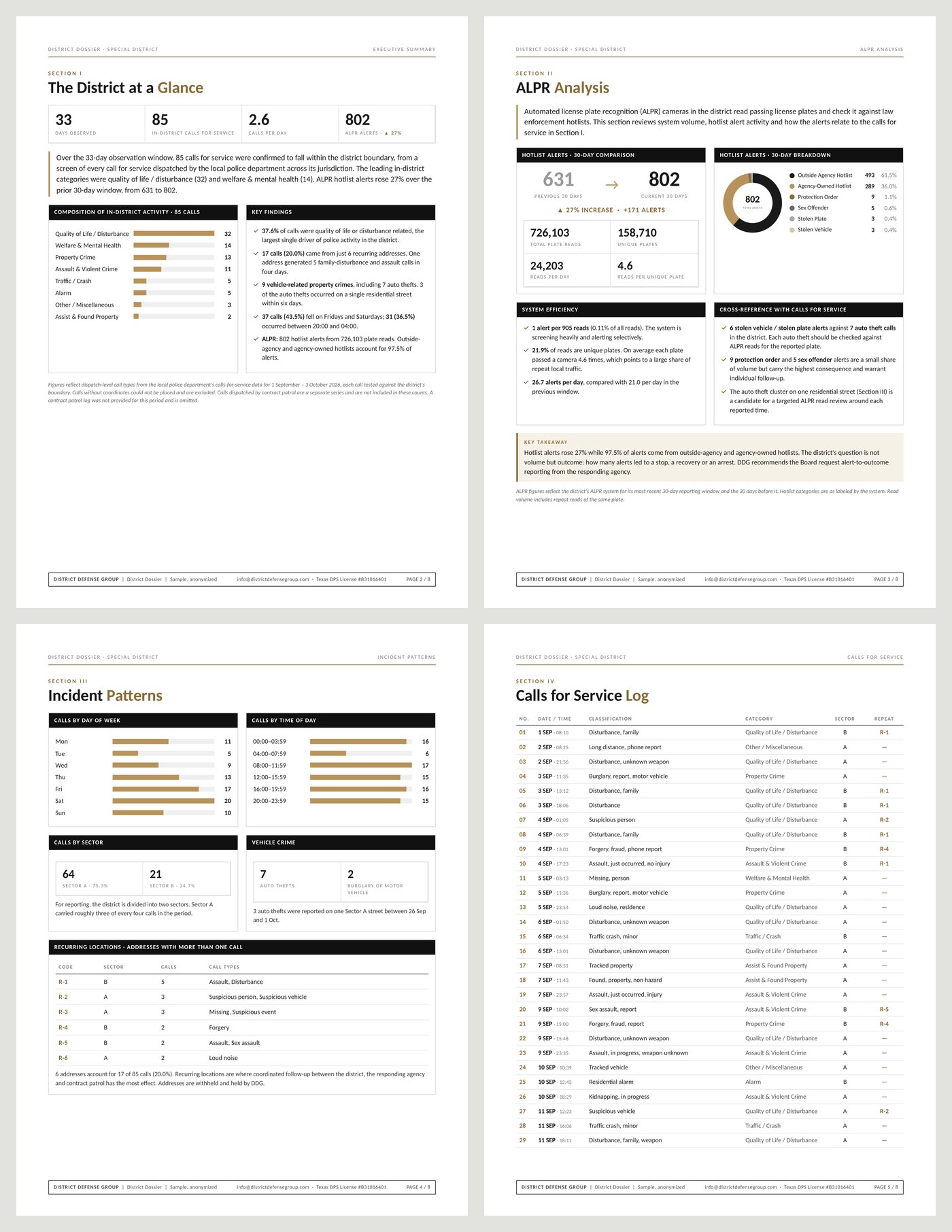
Each reporting period, DDG turns crime, incident, patrol, and available intelligence data into a concise Board-level briefing, showing what happened, what changed, where resources are being used, and what requires action.
In this dossier
- 1District at a glance: activity by category and key findings
- 2ALPR analysis: hotlist alerts, plate reads and cross-reference
- 3Incident patterns: day, time, sector and recurring locations
- 4Calls for service log, anonymized
- Board Update ReportsRecurring situational awareness and performance reporting.
- District Risk ProfilesA baseline picture of crime, risk, resources, and public safety conditions.
- Crime & Intelligence AnalysisTrends, patterns, activity, and emerging concerns drawn from available data sources.
- Action PlansPrioritized, budget-ready recommendations tied to identified risks and needs.
See the trends.
Measure the impact.
Turn crime data and calls for service into actionable intelligence. Our interactive dashboard reveals emerging trends, tracks changes over time, and helps districts evaluate the effectiveness of investments in law enforcement, technology, and other public safety initiatives.
Since resources were deployed
Calls over time
Incident map
When calls happen
day × timeCalls by category
Weekly trend by category
Weeks start Monday · same scale in every panel · gold line marks the deploymentRecurring locations
select to view on the mapCalls for service
This sample shows the crime analysis dashboard DDG builds for a district. Calls are real, anonymized dispatch records. Map points are placed on streets in an unrelated neighborhood and do not mark where any call happened. The deployment marker is an example; for a district it is the actual date resources went into service.
Where to
start.
If the answer to any of these is "we're not sure," that's the place to begin.
- 01
Do we know where and when public safety issues are occurring across our district?
- 02
Do we know whether our public safety resources are aligned to those risks?
- 03
Are we using the data and technology we're already paying for, or simply collecting it?
- 04
Does the Board receive clear, regular reporting on public safety activity, performance, and outcomes?
Intelligence-led
patrol.
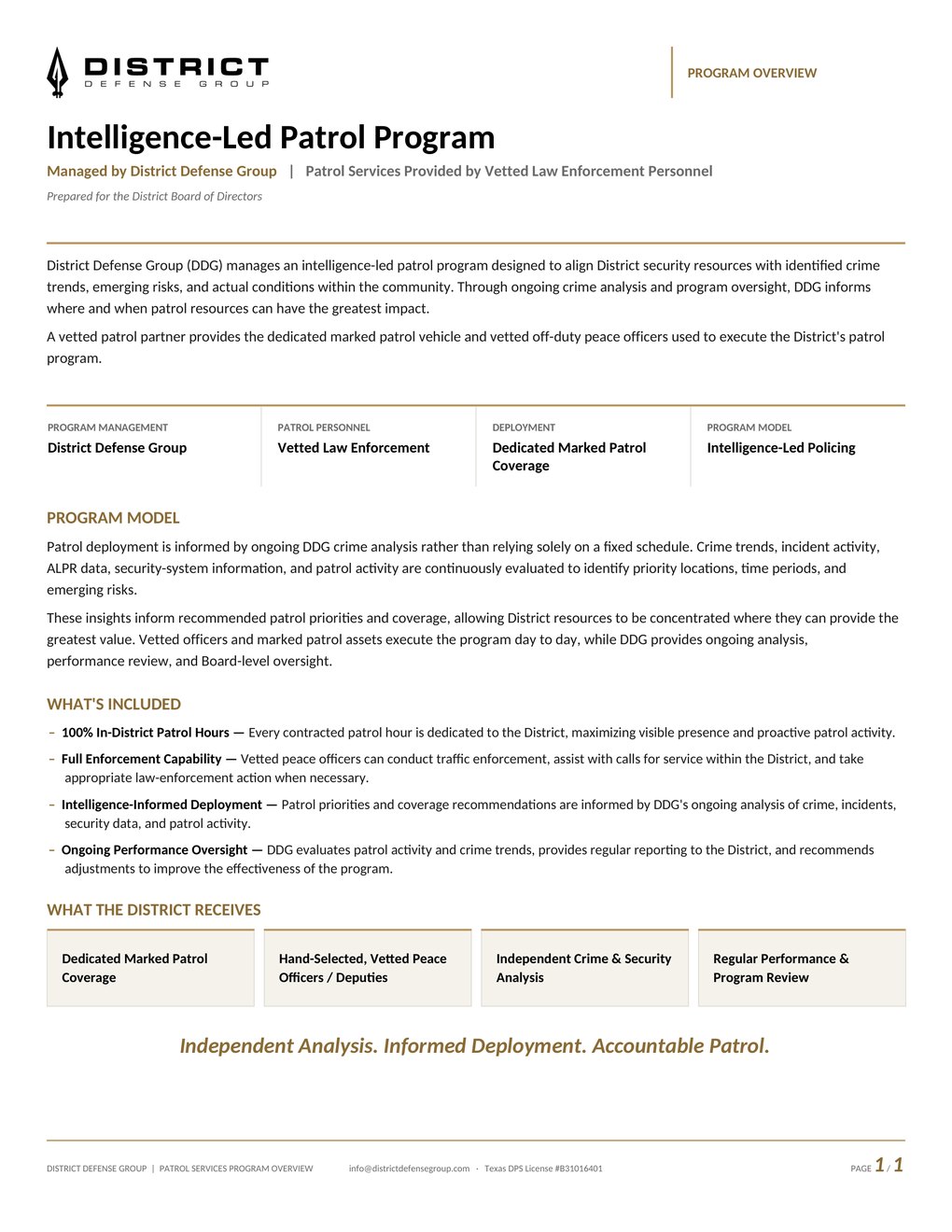
Patrol shouldn't be measured simply by hours purchased. DDG helps districts use crime, incident, and activity data to determine where resources are needed, coordinate priorities with law enforcement, and measure whether the program is producing value.
- 100% in-district patrol hours — every contracted hour stays in the district.
- Full enforcement capability — traffic enforcement, calls for service, and law-enforcement action.
- Ongoing performance oversight — regular reporting and recommended adjustments.
Units deployed
where the need is.
Beyond regular patrol, dedicated units can be deployed for specific needs. Each deployment is planned from the data, coordinated with law enforcement, and reported back to the Board.
Special circumstances
A specific incident, threat, or community concern that calls for focused, temporary coverage.
Crime trends
Targeted deployments where crime, incident, or ALPR data shows activity rising in a particular area or time window.
Events
Community events, district facilities, and seasonal activity that bring more people, traffic, or risk.
From assessment through implementation and ongoing oversight, DDG remains accountable to one interest: the district's.
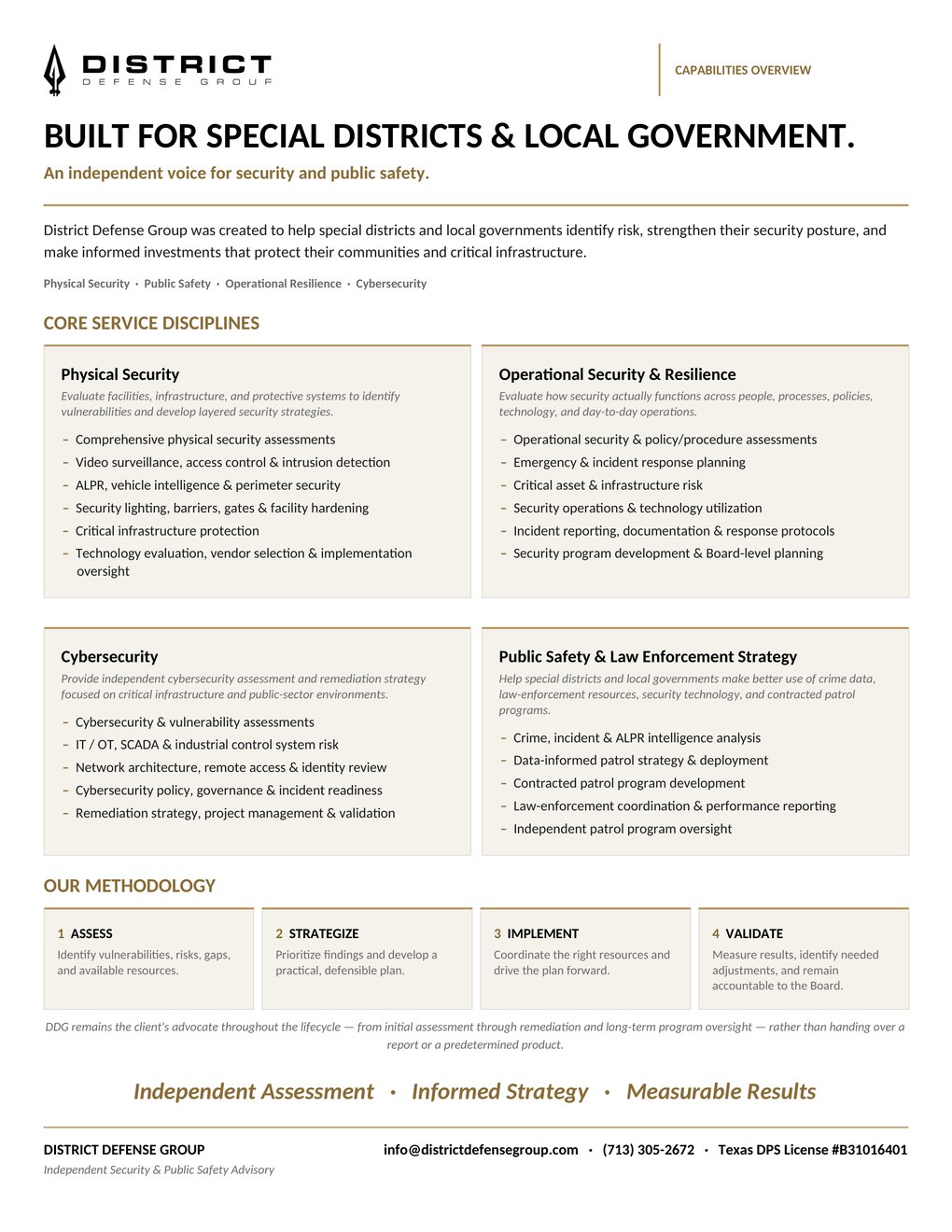
- 01AssessIdentify vulnerabilities, risks, gaps, and available resources.
- 02StrategizePrioritize findings and develop a practical, defensible plan.
- 03ImplementCoordinate the right resources and drive the plan forward.
- 04ValidateMeasure results, identify needed adjustments, and remain accountable to the Board.
Take it
to the board.
Download and circulate before your next board meeting.
One accountable
partner.
Security risks rarely stay in one category. DDG brings physical security, public safety, operational resilience, and cybersecurity into one coordinated strategy.
Not sure where to start? Let's talk.
We'll help you identify where your district's real risks are.