
OT cybersecurity for critical infrastructure.
DDG helps districts understand and reduce cyber risk across the operational technology that keeps essential infrastructure running, from SCADA and control systems to pumps, lift stations, and treatment equipment.
An important
distinction.
Most cybersecurity providers focus on IT: office computers, email, records, and business systems. OT is different. These are the control systems that physically operate district infrastructure. They work differently, fail differently, and need to be assessed and protected differently.
Office networks, email, records, and business systems
District control systems can sit here
DDG, on behalf of the BoardInstalled control equipment, integrators, and operators
A district can have a well-managed IT network and still have control systems reachable from the internet. Both matter, but an OT incident can interrupt water service and physical operations.
How DDG helps.
DDG helps the Board understand the district's current OT security posture: where systems are exposed, who can access them, how vendors connect, and what deserves attention first. We then coordinate the right technical resources to remediate identified risks, validate the work, and maintain ongoing visibility into the environment.
OT cybersecurity & vulnerability assessments
Identify vulnerabilities and potential attack paths across SCADA, control networks, remote access, plant workstations, and connected infrastructure, without disrupting live operations.
SCADA, PLC & industrial control system risk
Evaluate the controllers and industrial communications that run pumps, valves, and treatment processes, including legacy equipment that cannot simply be patched or replaced.
IT / OT boundary & network segmentation
Map where office networks, cameras, WiFi, and the internet touch control systems, and separate them so only required communications are allowed.
Remote access, vendor access & identity
Determine who can reach the control environment, from staff to integrators and equipment vendors, and make sure every connection is authorized, secured, and logged.
Policy, governance & incident readiness
Establish the policies, roles, and response plans that let the district act quickly during an incident, aligned with recognized OT and water-sector frameworks.
Remediation strategy, project management & validation
Turn findings into a prioritized plan, coordinate qualified technical resources, plan and test changes before they reach live systems, and verify the work was completed and documented.
24/7 threat monitoring & Board reporting
Maintain continuous visibility into the operational environment after remediation, with defined escalation and regular reporting to the Board.
We stay on watch.
Remediation establishes a stronger security posture. Continuous monitoring is what maintains it. Once identified risks are addressed, DDG can support 24/7 monitoring of the district's operational environment, so suspicious activity is caught early, the right people are notified, and the Board keeps clear visibility into how its control systems are protected.
- 24/7 monitoring of control systems and the networks that connect to them
- Detection of suspicious activity and potential intrusions
- Defined alert and escalation paths to district operations
- Coordinated incident response if something is detected
- Regular reporting that gives the Board meaningful visibility into its security posture
Where to
start.
If the answer to any of these is "we're not sure," that's the place to begin.
- 01
Do we know everything that is connected to our control systems?
- 02
Who has remote access to our plants, and is it monitored?
- 03
Would we know if someone was inside our network right now?
- 04
Are our vendors' remote connections secured and logged?
What does your
district operate?
Enter the number of facilities your district operates to establish a preliminary scope for an OT cybersecurity assessment. Estimates are fine. We’ll validate the details with your team.
Local industrial controllers, touchscreens, cellular/radio communications, and related control equipment.
Industrial controllers, operator interfaces, workstations, communications, and related control systems.
Treatment process controls, operator workstations, communications, and related industrial control systems.
Administrative networks and systems that may interact with the district’s operational environment.
0 locations identified
Your OT environment
at a glance.
0 locations identified
DDG will validate the environment, connectivity, and assessment requirements with your district and technical stakeholders before developing the final assessment scope.
This is a planning tool, not a cybersecurity assessment or risk rating.
What we've
actually found.
In one Texas water district engagement, DDG found that control systems the district believed were isolated could be reached from the internet.
Read the case studyNo industrial firewall
- Unattended remote access
- No intrusion detection
- No network traffic monitoring
From assessment through implementation and ongoing oversight, DDG remains accountable to one interest: the district's.
- 01AssessIdentify vulnerabilities, risks, gaps, and available resources.
- 02StrategizePrioritize findings and develop a practical, defensible plan.
- 03ImplementCoordinate the right resources and drive the plan forward.
- 04ValidateMeasure results, identify needed adjustments, and remain accountable to the Board.
Take it
to the board.
Download and circulate before your next board meeting.
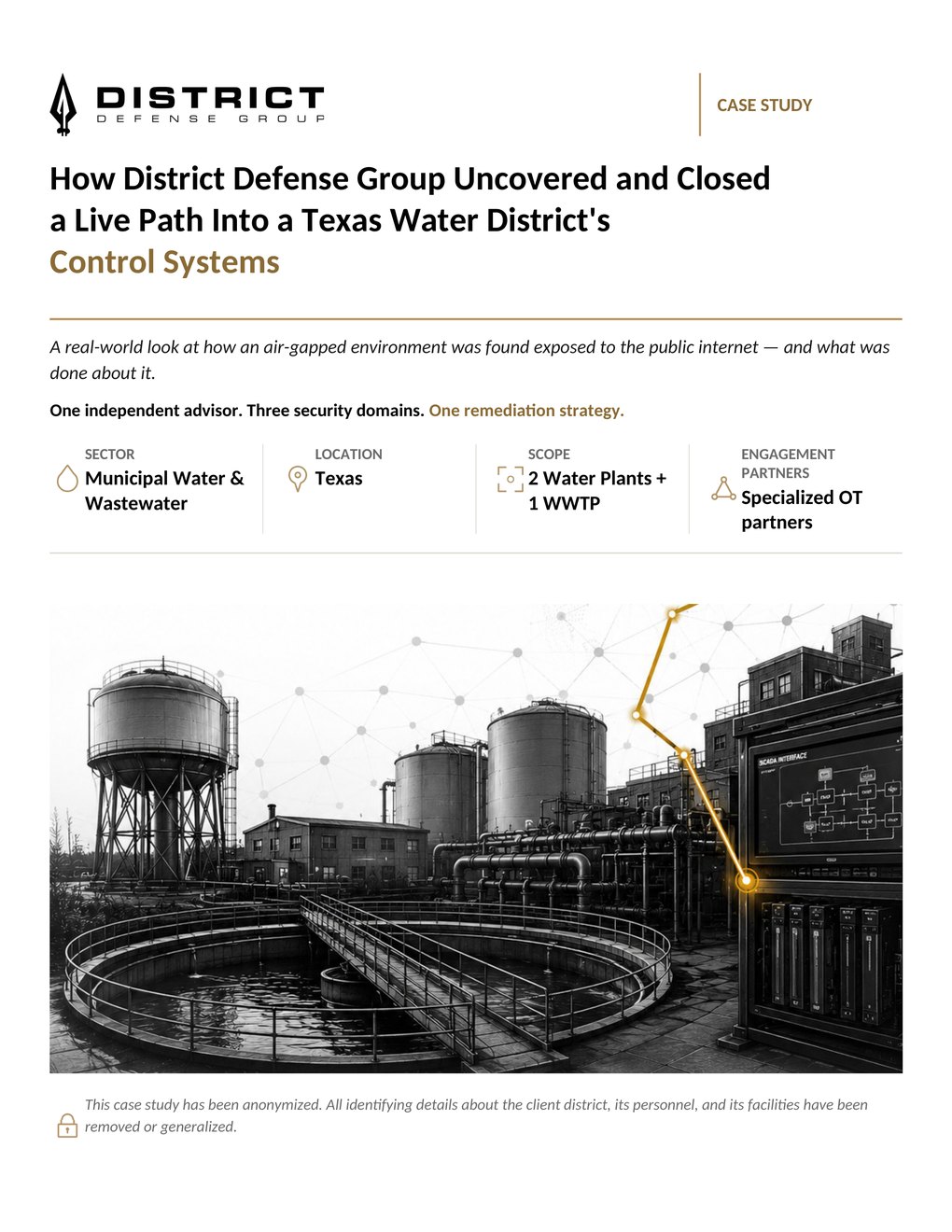 Case Study
Closing a Live Path Into Control Systems
An anonymized look at how a water district's control-system exposure was found and remediated.
Download PDF ↓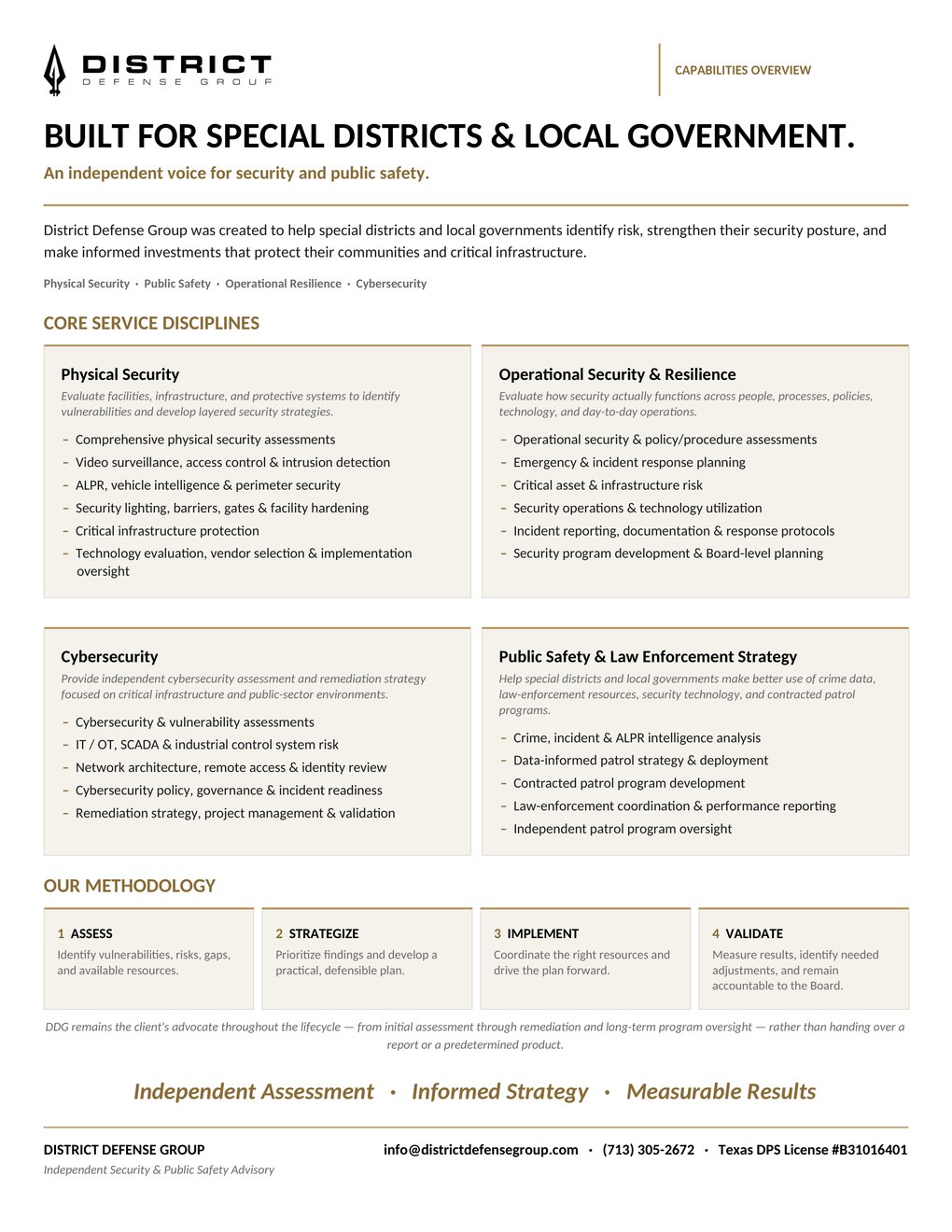 Capabilities
DDG Capabilities Overview
Independent security and public safety advisory for special districts and local government.
Download PDF ↓One accountable
partner.
Security risks rarely stay in one category. DDG brings physical security, public safety, operational resilience, and cybersecurity into one coordinated strategy.
Not sure where the gaps are? That's where we start.
We'll help you understand how your operational environment is protected today, where the district may be exposed, and what deserves attention first.